
Six Reasons Your Thyroid Labs Come Back 'Normal' While You Feel Like Hell
Six Reasons Your Thyroid Labs Come Back "Normal" While You Feel Like Hell
You're exhausted by 2 PM. Your brain feels like it's running through wet concrete. You've gained 15 pounds without changing anything. Your hair is thinning. Your hands and feet are always cold.
So you go to your doctor. They run a TSH. It comes back 2.8.
"Your thyroid is fine."
You leave the office feeling crazy. Because you know something is wrong. Your body has been screaming it at you for months. But the number on the paper says otherwise, and that's the end of the conversation.
Here's the thing about that number: TSH is a pituitary hormone. It tells you what your brain is asking for. It tells you almost nothing about what your cells are actually getting. Ordering TSH alone to evaluate thyroid function is like checking oil pressure to diagnose a transmission problem. You're looking at the wrong system.
I've seen this pattern hundreds of times. The patient isn't crazy. The testing is incomplete.
The Problem With "Normal"
The standard reference range for TSH runs from about 0.5 to 4.5 or 5.0 mIU/L, depending on the lab. That range was built from population data that included people with undiagnosed autoimmune thyroid disease. It's a statistical bell curve, not a health range.
Normal is not the same as optimal.
Functional ranges narrow that window considerably. Kharrazian places the functional TSH range at 1.8 to 3.0. The IFM Textbook of Functional Medicine flags anyone above 2.5 as a candidate for developing hypothyroidism who should be followed closely. But most conventional doctors won't even raise an eyebrow until TSH crosses 5.0 or higher.
That gap between 2.5 and 5.0 is where millions of people live in misery with a "normal" lab slip in their hand.
And TSH is only the beginning of the problem.
Six Patterns, One Diagnosis
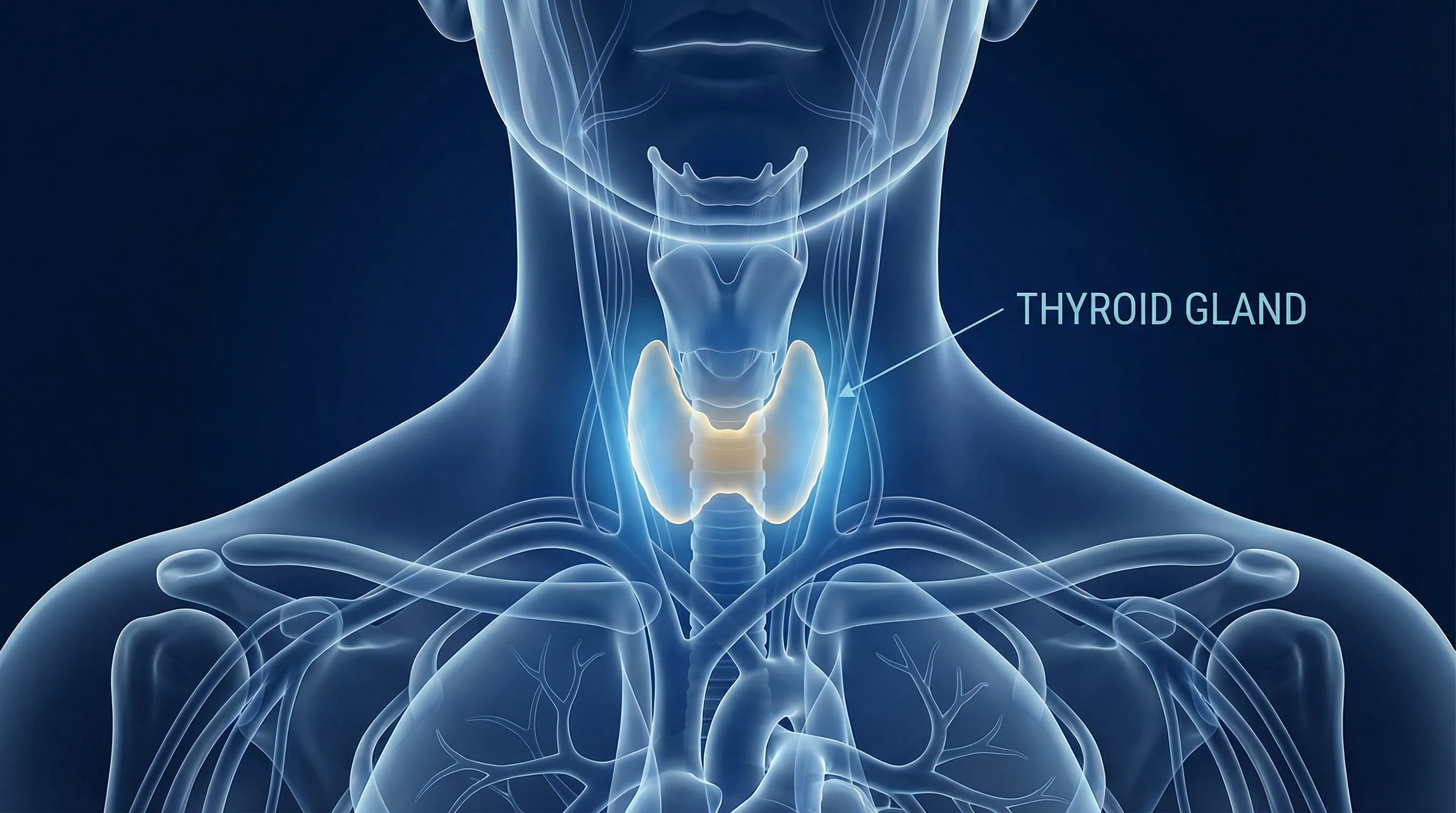
Dr. Datis Kharrazian, one of the sharpest functional medicine minds working today, identified six distinct patterns of low thyroid function. Only one of them responds to thyroid hormone replacement. The other five produce every hypothyroid symptom in the book while labs look clean on a standard panel.
This is the framework I use in my practice. Every thyroid case gets evaluated against all six patterns before we make a single recommendation.
Pattern 1: Primary Hypothyroidism
This is the only pattern most doctors know.
TSH goes up. T4 goes down. The thyroid gland itself is failing. Levothyroxine or a glandular gets prescribed. If it's autoimmune (Hashimoto's), the antibodies are positive.
About 90% of hypothyroidism in the US is autoimmune. That matters because treating autoimmune thyroid disease with thyroid medication alone is treating a symptom. You need to address the immune system, not just the gland it's destroying.
But this is the straightforward one. The other five are where people fall through the cracks.
Pattern 2: Pituitary Hypofunction
This is the most common functional pattern I see in practice.
TSH comes back low or low-normal (below 1.8). T4 is normal or slightly low. Most doctors see a low TSH and think "hyperthyroid" or, more commonly, think nothing at all. The number is in range. Case closed.
What's actually happening: chronic stress has exhausted the pituitary gland. It's stopped sending adequate signals to the thyroid. The brain has essentially turned down the thermostat because it's been running the stress response for so long that the pituitary can't keep up.
This is the postpartum depression pattern. New mothers come in with TSH around 1.5 to 1.7, dismissed as normal, while their energy, mood, and cognitive function are in the basement. It's also the pattern I see in high-performing executives, endurance athletes, and anyone who has been grinding under chronic stress for years.
The fix is not thyroid medication. It's adrenal and pituitary support. Rubidium sulfate, sage leaf, pituitary glandulars, and above all, addressing whatever is driving the chronic stress response.
Pattern 3: Under-Conversion
Here's where things get invisible to standard testing.
TSH is normal. T4 is normal. But T3, the active hormone your cells actually use, is low. Most doctors never order T3. They order TSH, maybe free T4, and call it a day.
Your thyroid makes T4 as a storage hormone. An enzyme called 5-prime deiodinase converts T4 into T3, the form that drives your metabolism, your body temperature, your energy, your brain function. When cortisol is chronically elevated or systemic inflammation is present, that enzyme gets suppressed. You have plenty of T4 floating around. None of it is converting to T3.
Your TSH won't budge because T3 levels don't significantly influence TSH production. The pituitary is happy. Your cells are starving.
This pattern requires a full thyroid panel: TSH, free T4, free T3, and reverse T3. If free T3 is low while free T4 is normal, you've found it. The intervention targets inflammation and cortisol, not the thyroid gland itself. Selenium, zinc, glutathione support, phosphatidylserine at therapeutic doses (around 2,000 mg/day liposomal), and a hard look at whatever is driving the inflammatory load.
Pattern 4: Over-Conversion and Decreased TBG
This is the insulin resistance pattern.
TSH looks normal. Free T4 and free T3 are both high-normal or elevated. T3 uptake is high. On paper, it looks like the thyroid is doing great. The patient still has every hypothyroid symptom.
What's happening: elevated testosterone (from insulin resistance or PCOS) decreases thyroid binding globulin. Too much T4 converts to T3 at once. Cells get flooded and become resistant. It's the same concept as insulin resistance applied to thyroid hormones. Receptor downregulation from chronic overstimulation.
This pattern affects an estimated 25 to 35% of the developed world, because that's the prevalence of insulin resistance. In women, it's often the PCOS connection: insulin resistance drives testosterone, testosterone drops TBG, thyroid hormones flood the receptors, cells stop responding.
You fix this by fixing insulin resistance. Chromium, alpha-lipoic acid, magnesium, inositol. Dietary intervention targeting blood sugar stability. The thyroid was never the problem.
Pattern 5: TBG Elevation
The opposite of Pattern 4.
TSH is normal. Free T4 is low. Free T3 is low. T3 uptake is low. There's plenty of thyroid hormone being produced, but it's all bound up on transport proteins and can't reach the cells.
The cause is almost always excess estrogen. Oral contraceptives. Estrogen replacement therapy. Estrogen-containing topical creams. Even environmental xenoestrogens in plastics and personal care products. Excess estrogen stimulates the liver to produce more thyroid binding globulin. More binding globulin means less free hormone available to tissues.
I see this in women on birth control who develop hypothyroid symptoms within 6 to 12 months of starting. Their doctor runs TSH. It's normal. They're told it's not their thyroid. Nobody checks TBG, free T4, or T3 uptake.
The fix: support liver Phase I and II detoxification pathways. Methylation support (methylfolate, B12, B6, trimethylglycine). Bile support for estrogen clearance. And a conversation about the estrogen source.
Pattern 6: Thyroid Resistance
This is the one that makes patients feel like they're losing their minds.
Every lab marker is normal. TSH, T4, T3, antibodies, all of it. Everything looks perfect on paper. The patient is cold, fatigued, gaining weight, losing hair, and can't think straight.
Chronically elevated cortisol has made the cells resistant to thyroid hormones. The hormone is in the blood. It reaches the receptors. The receptors don't respond. Like shouting at someone wearing noise-canceling headphones. The volume is fine. The reception is broken.
Elevated homocysteine can contribute. Chronic psychological stress is the primary driver.
You won't find this on any lab test. You find it by looking at the patient, listening to the symptoms, ruling out the other five patterns, and checking cortisol rhythm via salivary testing. If cortisol is dysregulated and every other thyroid marker is clean, you're looking at Pattern 6.
The fix is the adrenal protocol: identify and address the stress, support cortisol rhythm, and wait for receptor sensitivity to recover. This can take months.
What a Complete Thyroid Workup Actually Looks Like

If your doctor runs TSH and nothing else, they can only catch Pattern 1. That leaves five patterns invisible.
A proper functional thyroid evaluation includes:
- TSH (pituitary signal, not thyroid function)
- Free T4 (storage hormone production)
- Free T3 (active hormone at the cellular level)
- Reverse T3 (stress and inflammation marker)
- TPO antibodies (autoimmune screening for Hashimoto's)
- Thyroglobulin antibodies (second autoimmune marker, often missed)
- T3 uptake (binding globulin assessment)
- Basal body temperature (3-day morning average, should be 97.6\u00B0F or higher)
- Full adrenal assessment (4-point salivary cortisol + DHEA)
Without all nine data points, you're guessing. And for five out of six patterns, you'll guess wrong.
The Deal Breakers
Even with the right diagnosis, thyroid support won't work if certain foundations are broken. Kharrazian calls these "deal busters," and they have to be addressed first:
Anemia. If you can't carry oxygen to cells, no hormone protocol will matter. Check CBC, ferritin, iron, TIBC, B12, and folate.
Blood sugar dysregulation. Unstable blood sugar exhausts the adrenals, which exhausts the pituitary, which crashes thyroid signaling. This is the most common adrenal stressor I see in practice. If someone is skipping meals, crashing at 3 PM, or getting shaky between meals, fix the blood sugar before touching the thyroid.
Gut infections and food sensitivities. Chronic immune activation from gut pathogens or reactive foods creates a constant cortisol demand. Up to 88% of Hashimoto's patients improve by removing gluten alone (Wentz, 2013, survey of 2,232 patients). Gluten, dairy, and soy are the top three triggers.
Essential fatty acid deficiency. Required for hormone synthesis and cell membrane integrity. If the membrane is damaged, the receptor doesn't work.
Why This Matters
Roughly 20 million Americans have some form of thyroid disease. Up to 60% are undiagnosed. That's 12 million people walking around with symptoms that are being dismissed, medicated around, or attributed to aging, depression, or "stress."
The body doesn't lie. It signals constantly. Fatigue, weight gain, brain fog, hair loss, cold extremities: these are not personality traits. They're clinical findings. They deserve a thorough investigation, not a single lab value and a shrug.
If your TSH came back normal and you still feel terrible, you're not imagining it. You just haven't been tested properly.
In my practice, every patient gets the complete picture. All six patterns evaluated. Functional ranges, not statistical averages. Because "normal" labs with abnormal symptoms isn't a clean bill of health. It's an incomplete investigation.
Dr. Aren Nilsson is a Doctor of Chiropractic and performance strategist based in Georgia, specializing in hormone optimization and root-cause medicine.
Keep Reading

The 63 ng/dL Wake-Up Call: Why Every Man Should Get His Hormones Checked
At 19, my testosterone was lower than most 80-year-olds. Here’s how I found out, what it was doing to my brain and body, and why the medical establishment’s “normal range” is failing millions of men.

Root-Cause Medicine Is Not Alternative Medicine. It’s Better Medicine.
The false dichotomy between conventional and alternative medicine is keeping people sick. Root-cause medicine isn’t anti-establishment. It’s what the establishment should have been doing all along.